
Introduction
For most estates and facilities teams, a boiler replacement starts in one of two ways. Either a boiler fails, usually during the first cold spell of the year, or a condition survey or decarbonisation plan puts a date on a replacement that has been deferred for some time. The first leaves little room to think. The second leaves time, but it is easy to spend that time on the wrong questions.
This guide covers what to weigh up before commissioning commercial boiler installation in Bristol and the wider South West: when to replace rather than repair, whether a boiler is still the right answer, what installation involves on a site that has to keep running, and what to look for in an installer.
When replacement makes more sense than repair
Repair remains sensible when a fault is isolated and the plant is otherwise in good order. Replacement becomes the stronger option when the pattern changes. Breakdowns become more frequent, particularly through the heating season. Parts for older plant become harder to source. Running costs rise while heat delivery becomes uneven across the building. Or a survey flags that the boilers, and often the pipework and controls around them, are reaching the end of their working life.
It’s worth looking beyond the boiler at this stage. Ageing pipework, failing valves and outdated controls limit what new plant can achieve, and a replacement scoped as boiler-only can leave the underlying problem in place. A survey of the whole heating circuit before equipment is specified gives the project a much better chance of performing as intended. If you are still weighing up a repair, our commercial boiler repair team can assess the plant first.
Boiler or heat pump?
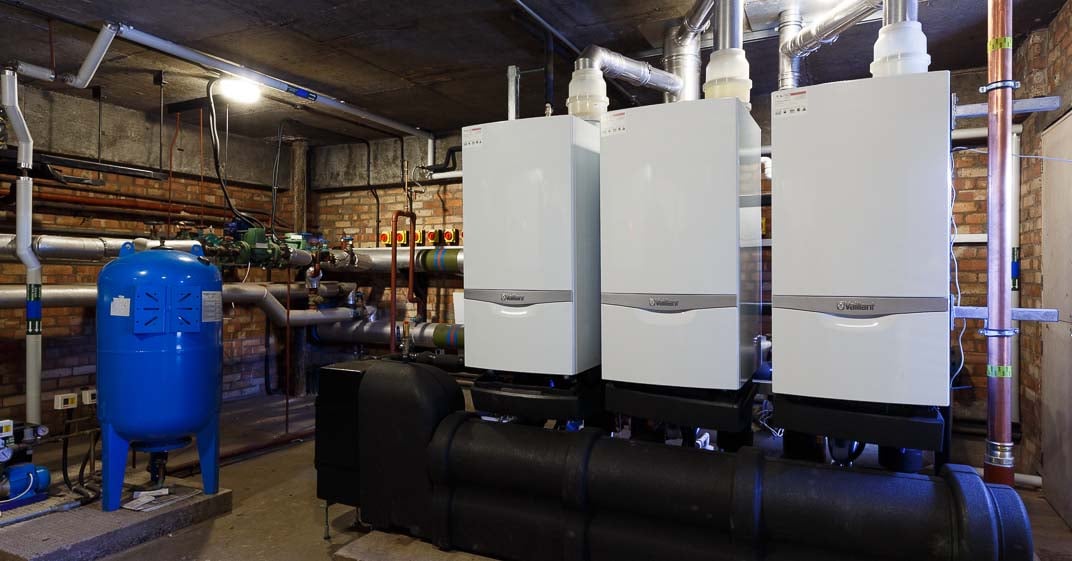
Anyone replacing commercial heating plant now has to ask this, particularly where a net zero commitment sits behind the project. The answer depends on the building. Heat pumps suit sites with good insulation, emitters that work at lower flow temperatures and enough electrical capacity to support them. Older buildings with high-temperature radiators and a constrained power supply often need other work first, and in those cases a high-efficiency condensing boiler is a sensible step, particularly when it is specified with controls that make a later transition easier.
Many projects land somewhere in between: efficient boilers now, with the pipework and controls designed so a heat pump or hybrid arrangement can follow. Where a heat pump is the right call, MCS certification is the benchmark to look for in an installer, and our commercial air source heat pump page covers that route in more detail. At survey stage, the aim is to make the decision on the building's actual condition and the organisation's targets, rather than on the general direction of travel.
What installation involves
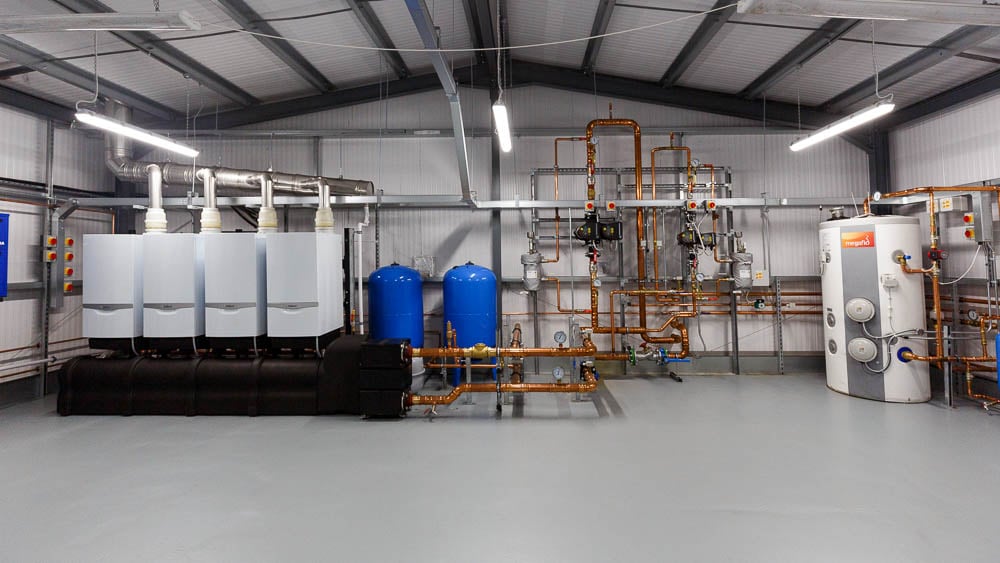
A well-run installation follows a clear sequence. A survey establishes the condition of the existing plant, pipework and controls, along with the constraints of the site. Design and specification follow, with the programme worked out against the building's calendar. Installation then covers removal of the old plant, new boilers, associated pipework, controls and electrical connections. Before handover, the system is flushed, commissioned and tested, and the client receives full documentation and training.
Gas Safe registered engineers must carry out all gas work, and it is reasonable to ask to see evidence of registration before work begins. Our commercial boiler installation page sets out how we approach each stage.
Keeping the site running
For schools, offices, depots and healthcare sites, the harder part is rarely the boiler itself. It’s changing the heating on a building people are using. Programme and communication do most of the work here: agreeing access and working areas with site staff in advance, scheduling the noisiest or most disruptive stages for quieter periods, and planning temporary heat where the building cannot be left cold.
Larkmead School shows how far that planning can go. Flooding had damaged the school's underground heating network, and the school could not close while it was put right. UES led the overhaul in phases around the school calendar, built a temporary classroom so teaching could continue and used the summer break for the most disruptive stages. The project was delivered on time and within budget, and the school stayed open throughout. You can read the full case study for the details.
What to look for in an installer
Gas Safe registration is the starting point. Beyond that, accreditations give a useful indication of how a contractor works. Our engineers are Gas Safe registered, and UES holds ISO 9001 for quality management and CHAS Elite for health and safety, alongside the other accreditations listed on our site.
Experience of live environments matters at least as much as the paperwork. Ask for examples of projects delivered on sites that stayed in use, find out how the contractor works with your staff day to day, and be clear on who your point of contact will be from survey through to handover.
When a boiler is part of something bigger
Where a boiler replacement comes with pipework renewal, electrical work, controls or fit-out, it can be more efficient to appoint one team to lead all of it. That is the role UES takes on as principal contractor, with one point of contact and one programme across every trade involved. Our principal contractor page explains how that works in practice.
If you are planning a replacement in Bristol or the South West, talk to us about your project and we will tell you honestly what we would recommend.